

Most borrowers applying for a bridging loan think about the valuation only in terms of the number that comes back — and whether it is high enough to support the loan they need. But behind that number is a structured bridging loan valuation process that a qualified surveyor carries out methodically, working through a series of specific criteria that determine both the market value and the lender’s confidence in the security. Understanding what the surveyor is actually assessing gives you a clearer picture of what might drive the figure up or pull it down — and why.
This is not the same ground covered by our broader guide to how a bridging loan valuation is carried out and how it can affect your offer. That guide explains valuation types and what happens when figures come in low. This article goes deeper into the surveyor’s inspection criteria themselves — the specific things a RICS bridging loan surveyor is trained to look for, assess, and document when they attend your property.
Why the bridging loan valuation process is different from a mortgage survey
Before examining what surveyors look for, it is worth understanding why the bridging loan valuation process places weight on specific factors that a standard mortgage survey might treat differently.
A residential mortgage valuation is primarily confirming that the lender is not paying over the odds for a property that will hold its value over a 25-year term. Speed is not a primary consideration — the lender has months, and the borrower’s income underpins repayment.
A bridging loan is secured almost entirely on the property itself. The lender needs to know not just what the property is worth today, but how quickly and reliably it could be sold if the borrower defaults. This shapes every aspect of what the RICS bridging loan surveyor is assessing. Their report does not just produce a market value. It typically produces one or more short-sale estimates — often a 90-day value and a 180-day value — that reflect what the property would achieve if it had to be sold urgently.
The surveyor is therefore always asking a dual question: what is this property worth, and how certain can a lender be that they could recover that value under pressure?
Structural condition: the surveyor’s primary concern
Structural integrity is the single most important factor in the bridging loan valuation process. A property with a compromised structure cannot be relied upon as security — even if its location, size, and finish are excellent — because the lender cannot be confident of recovering value in a forced sale.
A RICS bridging loan surveyor will assess structural condition on multiple levels:
Foundation and ground stability
Surveyors look for evidence of subsidence, which might present as diagonal cracking at door and window corners, sticking doors or windows, uneven floors, or visible gaps between a bay window and the main structure. They will also look for signs of heave — upward movement of the ground, which is common in clay soils after drought — and for any evidence that tree roots or drainage issues have destabilised the ground beneath the building.
Where subsidence is suspected but not confirmed, the surveyor may recommend specialist investigation, which could delay the valuation and the loan offer.
Roof structure and covering
The roof is one of the most expensive elements to repair and one of the most scrutinised in the bridging loan valuation process. Surveyors inspect visible roof covering for missing tiles, deteriorated felt, or corroding metal sections. They look at the ridge line for signs of bowing. On properties where roof space is accessible, they will check the structural timbers for sagging, rot, beetle infestation, or evidence of previous fire damage. Flat roofs receive particular attention — their lifespan is shorter than pitched roofs, and a failing flat roof can be expensive to replace.
External walls and pointing
Brickwork is examined for spalling (where the face of individual bricks breaks away, usually due to frost damage), crumbling mortar joints, damp penetration, and cracking patterns that indicate differential settlement. Cavity walls may be checked for signs that the cavity has been compromised by inadequate insulation installation or wall tie failure, which in older properties can require substantial remediation.
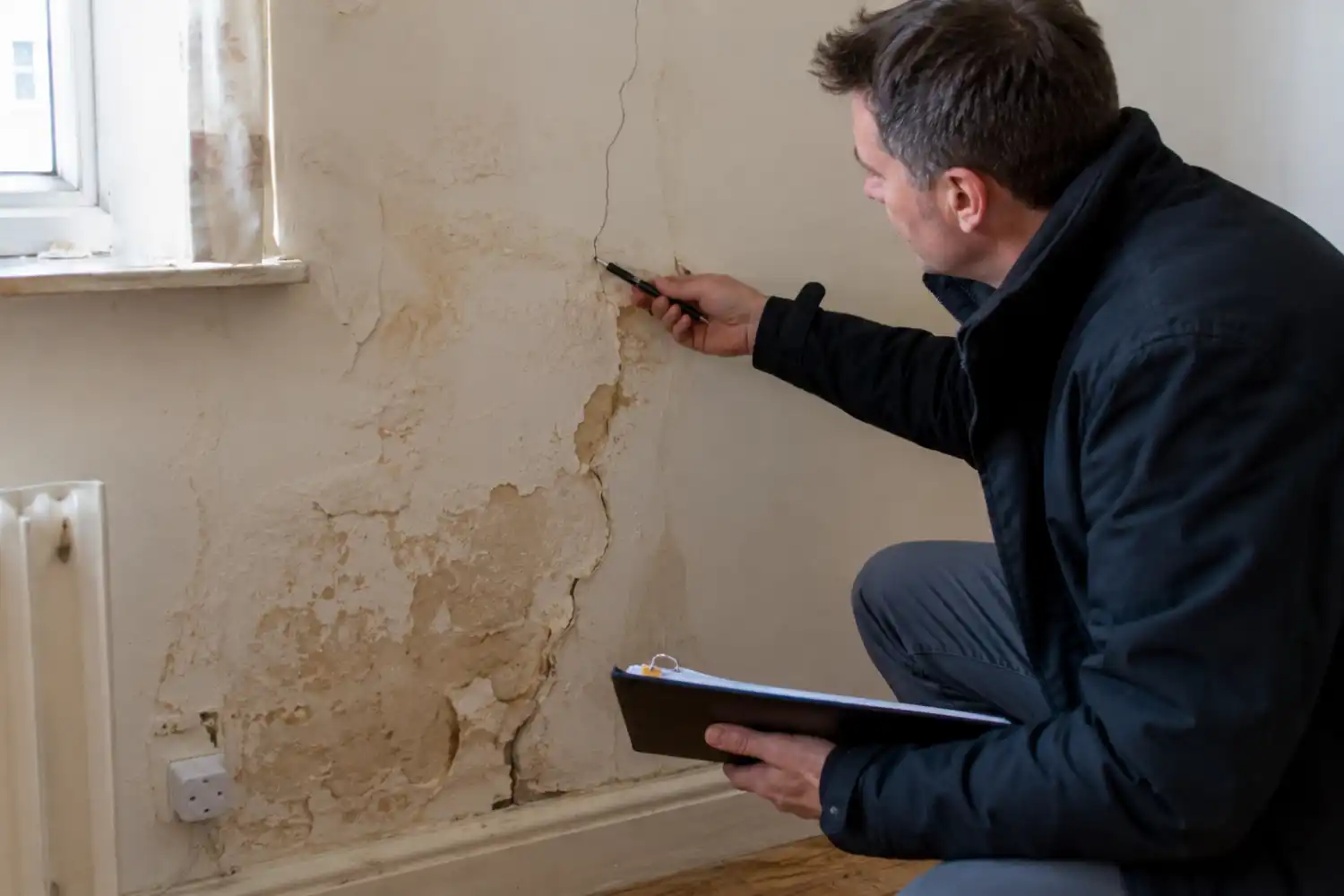
Damp — penetrating and rising
Damp is one of the most common issues to appear in the reports of a RICS bridging loan surveyor, and its significance depends on the source. Penetrating damp — water entering through the fabric of the building — can often be resolved through straightforward maintenance such as repointing or gutter repair. Rising damp, where moisture travels upward through masonry from ground level, is more serious and may indicate a failed or absent damp-proof course. Surveyors look for tide marks on lower walls, flaking plaster, salt deposits, and characteristic damp odour. Where significant damp is found, it will almost always be flagged in the report.
Property type and construction method
The construction method of a property directly affects what surveyors look for in a bridging loan valuation — specifically, how easy or difficult the property would be to sell or mortgage in a hurry. Standard brick and block construction is well understood by the lending market. Non-standard construction introduces variables that shrink the pool of potential buyers and therefore compress short-sale values.
Non-standard construction types that surveyors flag for lender attention include:
- Prefabricated concrete systems — including BISF houses, Airey, Wimpey No-Fines, and similar post-war builds
- Steel-framed construction — particularly common in certain eras of social housing
- Timber-framed buildings — depending on age, specification, and condition
- Properties with thatched roofs — due to higher insurance costs and limited lender appetite
- High-rise flats above a certain floor threshold — particularly where there is no lift or where cladding concerns exist
- Properties constructed with reinforced autoclaved aerated concrete (RAAC) — which has received significant attention following structural failures in public buildings
For any non-standard property, the RICS bridging loan surveyor will assess not just whether the structure is sound today, but whether the construction type is likely to affect the achievable sale price and whether specialist structural investigation is required before the lender can make an offer.
Services, installations, and compliance
The bridging loan valuation process extends beyond bricks and mortar. Surveyors also assess the visible condition of the property’s services — electrical, plumbing, heating, and drainage — not as a full engineering survey, but as a professional judgment of whether significant expenditure is likely and whether anything represents a safety or marketability risk.
Electrics
Where the electrical installation is visibly old — rewirable fuses, older consumer units, or aged wiring insulation — the surveyor will note this as a potential area of expenditure. They cannot see inside walls, but consumer unit condition, socket types, and visible wiring in accessible spaces give a reasonable indication of the age and standard of the installation.
Heating
The age, type, and apparent condition of the boiler and heating distribution system is noted. A boiler that appears to be beyond its expected service life — typically 10 to 15 years for a condensing boiler — is flagged as requiring replacement in the short to medium term. Where there is no central heating, the surveyor will note this as a factor affecting marketability.
Drainage
For properties not connected to mains drainage — those served by a septic tank or cess pit — the surveyor will flag this prominently. Since January 2020, septic tanks that discharge directly to a watercourse must be upgraded or replaced under Environment Agency regulations, and many older systems do not comply. Compliance status is relevant to both value and marketability.
Building regulations and planning compliance
Extensions, loft conversions, and other alterations that have been carried out without building regulations approval — or where the approvals cannot be evidenced — are flagged in the report and may lead the lender to require indemnity insurance or further investigation. This is one area where what surveyors look for in a bridging loan valuation directly connects to the legal due diligence being carried out by your solicitor in parallel.
Worried about how your property's condition might affect your valuation?
A valuation that surfaces structural issues, non-standard construction, or title complications can delay or reduce your bridging loan. Knowing what the surveyor is likely to flag — before the inspection — allows you to address issues or plan your response. Speak to our bridging loan solicitors to prepare your application with realistic expectations.
Location and marketability factors
Even a structurally sound property in excellent condition can produce a lower bridging loan valuation process outcome if the surveyor has concerns about location or marketability. These are factors that affect how quickly and easily the property could be sold if the lender needed to realise the security.
Key marketability factors assessed include:
Local market activity
The surveyor examines how active the local property market is — how many comparable sales have occurred recently, how long properties are taking to sell, and whether there is evidence of price growth or decline. In thin markets where comparable evidence is sparse, the surveyor must work harder to justify their figure, and conservative approaches under uncertainty will produce lower values.
Flood risk
Properties in flood risk zones receive particular scrutiny. Flood risk affects both insurability and saleability, and its impact on value depends on the specifics — flood zone, the type of flooding (surface water versus river or coastal), the availability of flood insurance at reasonable cost, and any flood mitigation measures in place. Surveyors will typically note the property’s flood zone as part of the bridging loan valuation process and comment on how it affects their assessment.
Environmental and planning constraints
Conservation area designations, listed building status, rights of way affecting the property, or proximity to significant infrastructure (flight paths, major roads, industrial uses) are all noted. These factors can reduce marketability to standard mortgage buyers and compress short-sale values.
Tenure and title
For leasehold properties, the surveyor will note the remaining lease term prominently. Below 80 years, leasehold properties become significantly harder to mortgage, which directly reduces the pool of buyers and therefore the achievable price in a forced sale. Issues with service charges, ground rent reviews, or the financial health of the landlord may also be flagged where they are apparent from available information. The legal title position is ultimately the solicitor’s responsibility, but surveyors and RICS bridging loan surveyors are alert to tenure characteristics that affect value and will cross-reference with the legal team where needed.
Comparable evidence: how the surveyor justifies the figure
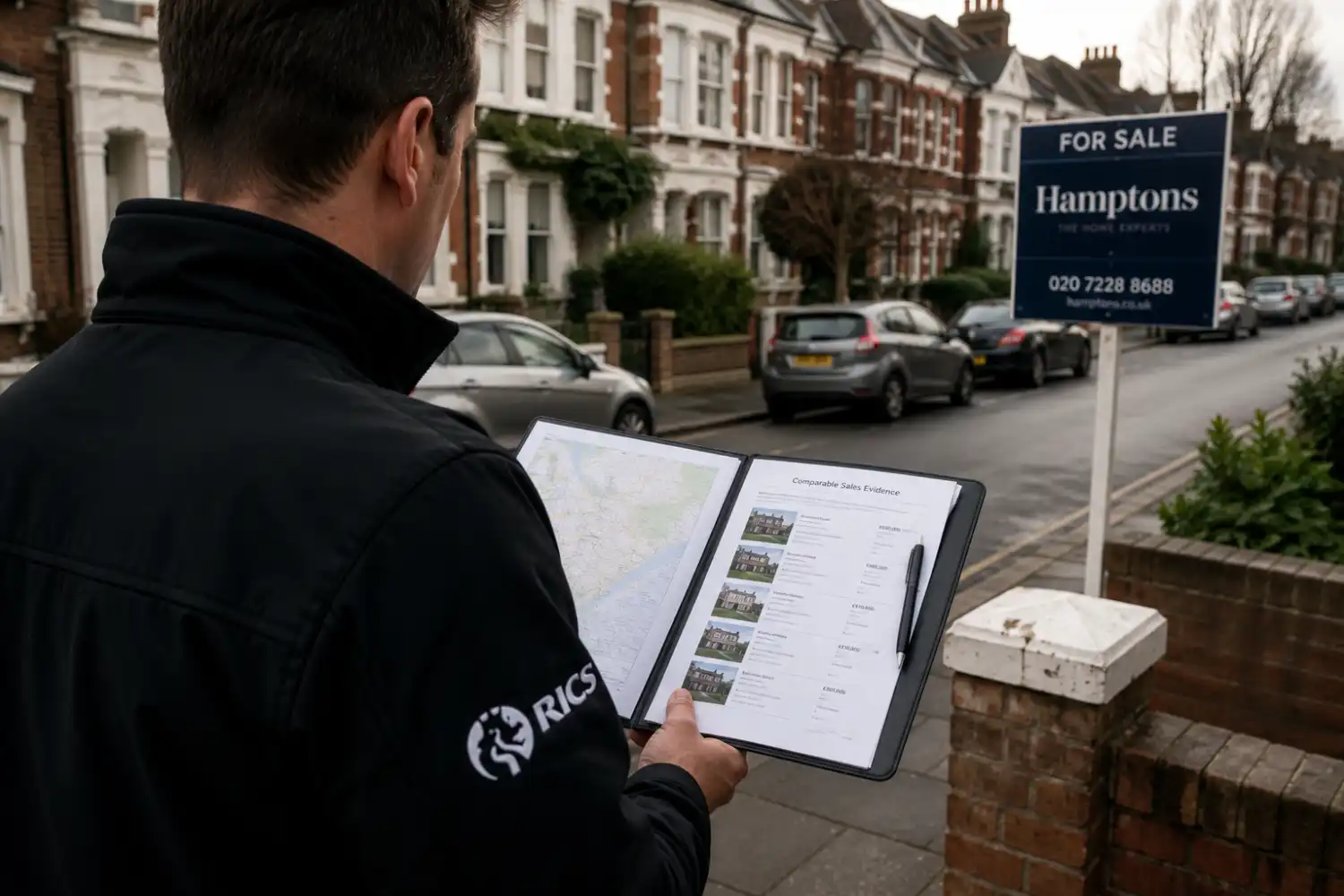
Once the surveyor has assessed the physical property, they must support their valuation figure with evidence. This is one of the most technically important parts of the bridging loan valuation process — and the part that most clearly illustrates why some properties are easier to value than others.
Comparable evidence consists of completed sales of similar properties in the same or nearby locations within a recent timeframe — typically the last three to six months, though this window may be extended in slow markets. A RICS bridging loan surveyor will look for comparables that match the subject property in type, size, age, condition, and location as closely as possible.
Where comparables are plentiful and closely matched, the surveyor can produce a figure with a high degree of confidence. Where they are sparse — because the property is unusual, the location is rural, or the market has been quiet — the surveyor must make more judgment calls, and professional caution under uncertainty will tend to produce a lower value.
This is why borrowers are sometimes frustrated when a property they believe is worth a specific amount comes back with a lower valuation. It is not necessarily that the surveyor disagrees with the intrinsic value — it may simply be that the comparable evidence available does not support that figure to the standard required by a Red Book valuation.
Understanding this dynamic before you apply — rather than after the report arrives — helps you plan more effectively. Our guide to the bridging loan application process timeline explains where the valuation sits in the wider sequence and how to manage each stage to protect your completion date.
Access, occupancy, and special circumstances
There are practical factors that affect the bridging loan valuation process beyond the property’s physical characteristics:
Occupied properties
Where a property is tenanted, the surveyor must arrange access with the occupant. A tenant who is uncooperative, or where access is restricted to certain rooms, can limit the inspection and force the surveyor to caveat their report. Lenders will not typically draw down until they have a satisfactory unrestricted inspection.
Vacant properties
Properties that have been vacant for an extended period often show deterioration at a faster rate than occupied ones — broken boilers are not noticed, water ingress develops unchecked, and the risk of vandalism or squatting increases. Surveyors conducting a bridging loan valuation process on a vacant property will pay close attention to signs of rapid deterioration, and lenders may impose conditions around security and insurance.
Properties requiring significant work
Where the purpose of the bridging loan is to fund refurbishment before sale or refinance, the surveyor will typically produce both a current value and a gross development value (GDV) — the estimated value of the property once the planned works are completed. The loan offer is typically based on the current value at completion, with draw-down against the GDV as works progress. This affects what surveyors look for in a bridging loan of this type: they are assessing not just the current state but the feasibility and likely outcome of the proposed works.
This type of application — where the bridging loan is funding a conversion or heavy refurbishment — carries additional risk that is relevant to understand before you proceed. Our overview of the risks of taking out a bridging loan covers the pressure points specific to development and refurbishment scenarios.
How the surveyor’s report affects the lender’s decision
The RICS bridging loan surveyor‘s report is a formal, professional document produced under the Red Book standards of the Royal Institution of Chartered Surveyors. Once it is received, the lender’s underwriter reviews it alongside the legal due diligence to determine:- Whether the headline valuation figure supports the requested loan amount at the agreed LTV
- Whether any conditions need to be attached — such as retentions pending remediation work
- Whether any issues in the report need to be resolved before completion can proceed
- Whether a specialist further investigation is recommended before the offer can be finalised
Get prepared before your bridging loan surveyor arrives
The bridging loan valuation process is not a passive event. Understanding what surveyors look for in a bridging loan valuation — from structural condition and construction type to comparable evidence and compliance documentation — allows you to enter the inspection stage with clear expectations, address obvious issues in advance, and respond effectively if the surveyor's figure affects your loan offer.
Our bridging loan solicitors act exclusively for borrowers. We work through the valuation stage alongside you — advising on what to expect, reviewing the lender's requirements once the report is returned, and managing the legal due diligence in parallel so that no time is lost between the valuation and completion.