

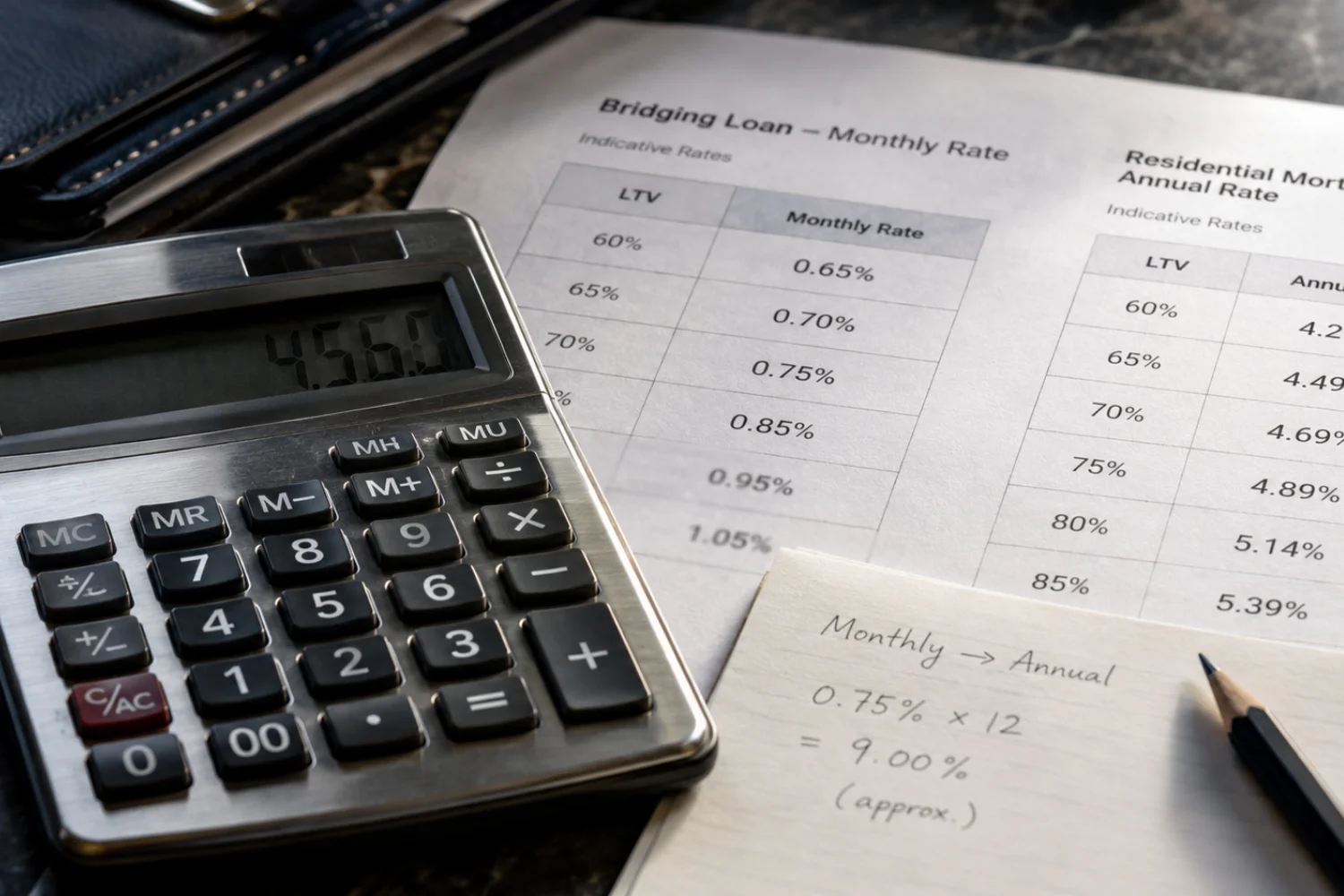
On the headline rate alone, a bridging loan is not cheaper than a mortgage. Bridging interest is typically quoted at 0.5% to 1.5% per month, which works out at roughly 6% to 18% a year, against standard residential mortgage rates currently sitting in the region of 4% to 6% a year. But that comparison only tells you half the story, because the real cost of either product depends heavily on how long you actually hold the debt for.
This guide walks through the real numbers: how bridging and mortgage costs compare on a like-for-like basis, what a worked example looks like over a typical bridging term, and when the higher headline rate on a bridging loan can still end up being the sensible — or even cheaper — route.
Why bridging loans and mortgages are hard to compare directly
Part of the confusion comes down to how each product is priced. Mortgages quote interest as an annual percentage, because they are designed to run for years. Bridging loans quote interest monthly, because they are designed to run for months. Before you can compare the two fairly, you need to convert one figure into the other.
The bigger issue is that a bridging loan and a mortgage are often not actually competing for the same job. Bridging finance is frequently used to secure a property quickly, with a mortgage arranged afterwards as the exit strategy — so in practice it’s less “bridging loan or mortgage” and more “bridging loan, then mortgage.” Whether that combination ends up cheaper than waiting for a mortgage alone depends entirely on your timeline and what you would have lost by waiting.
The headline rates, compared
Here’s how the two products stack up on rate alone, using typical UK figures for 2026:
| Bridging loan | Standard residential mortgage | |
|---|---|---|
| Typical rate | 0.5%–1.5% per month | Roughly 4%–6% per year (2026) |
| Annualised equivalent | Roughly 6%–18% per year | Quoted annually already |
| Typical term | 1–24 months | Usually 25–35 years |
| How it's assessed | Property value and exit strategy | Income, credit history and affordability stress test |
Bridging rates vary considerably depending on loan-to-value, property type and your exit strategy — our guide to current bridging loan interest rates breaks down the full rate bands. For general background on how mortgage interest is structured, MoneyHelper’s guide to mortgages and interest rates is a useful independent starting point.
What each loan actually costs you — not just the rate
The interest rate is only one part of the bill. Both products carry additional fees, and these matter more than people expect when the loan term is short.
Bridging loan fees typically include:
- Arrangement fee — usually 1–2% of the loan amount
- Valuation fee — typically £300–£1,000
- Legal fees — typically £800–£2,000+
- Broker fee, if used — typically around 1%
Mortgage fees typically include:
- Arrangement or product fee — anywhere from £0 to around £2,000, depending on the deal
- Valuation fee — often included free with many mortgage products
- Legal fees — sometimes covered by the lender as an incentive, especially on remortgages
Our article on the full breakdown of bridging loan costs and fees covers the bridging side of this in more depth, including how rolled-up, retained and serviced interest are each charged.
A worked example: the real cost over 6 months
Numbers make this easier to picture. Here’s an illustrative comparison for borrowing £250,000 for six months — first through a bridging loan at a mid-range rate of 0.75% a month, then what the equivalent six months would cost if the same amount were financed through a mortgage at a representative rate of 5% a year.
| Cost | Bridging loan (6 months) | Mortgage-equivalent (6 months) |
|---|---|---|
| Interest | £11,250 (0.75%/month × 6) | £6,250 (5% pa, pro-rated) |
| Arrangement fee | £3,750 (1.5%) | £2,500 (1%) |
| Valuation fee | £600 | £300 |
| Legal fees (loan-related) | £1,400 | £500 |
| Approximate total | £17,000 | £9,550 |
On this illustration, the bridging loan costs roughly £7,500 more over the same six-month period. That gap is the price of speed and flexibility: no income affordability test, no lengthy underwriting, and a facility that can complete in days rather than months. These figures are illustrative only — actual rates, fees and total costs depend on the lender, your loan-to-value, the property, and your individual circumstances, and should always be confirmed with a quote before you proceed.

Weighing up whether bridging is worth the extra cost?
A solicitor can review the numbers, the loan agreement and your proposed exit strategy together, so you know exactly what you're committing to before you sign anything. Book a Free Consultation
What happens if a bridging loan runs for longer than planned
The worked example above only holds up if the loan is repaid on schedule. Because bridging interest compounds monthly rather than annually, letting a bridge run on becomes disproportionately expensive the longer it continues — which is exactly why lenders scrutinise your exit strategy so closely before approving a loan.
To put the other end of the timeline in perspective: the same £250,000 borrowed through a 25-year repayment mortgage at 5% a year would cost roughly £185,000–£190,000 in total interest over the full term — again, an illustrative figure that depends on the actual rate and product. That’s obviously far more in absolute terms than a six-month bridge, but it’s spread across 25 years rather than six months, which is precisely why bridging finance is priced and structured as a short-term tool, not a long-term alternative to a mortgage.
If your bridging loan is at risk of running past its term, our guides on how lenders assess your exit strategy and the disadvantages of a bridging loan are worth reading before you commit.
When a bridging loan can still be the right — or only — option
There are situations where the cost comparison above isn’t really the point, because a mortgage simply isn’t available in the timeframe or for the property in question:
- Auction purchases, which typically require full completion within 28 days — far too fast for standard mortgage underwriting
- Broken property chains, where you need to move quickly to avoid losing a purchase
- Properties in poor or uninhabitable condition, which most mortgage lenders won’t touch until renovation work is done
- Time-sensitive opportunities, where the cost of losing the deal outweighs the extra cost of bridging finance
For auction purchases specifically, our guide on financing an auction property safely sets out how to weigh up the two options before you bid. And for a broader view of who bridging finance genuinely suits, see who a bridging loan is best for.
When a mortgage is almost always the cheaper choice
If the property is mortgageable, there’s no hard deadline forcing a fast completion, and you meet standard affordability criteria, a mortgage will almost always work out cheaper over any meaningful holding period. There’s rarely a good reason to pay bridging rates for a purchase a mortgage could handle just as well.
If speed isn’t your main constraint, it’s worth reading our guide to cheaper alternatives to a bridging loan, which covers remortgaging, second-charge mortgages and other lower-cost options in more detail.
So, is a bridging loan cheaper than a mortgage?
Not on rate, and not if you hold the debt for years rather than months. But cost in isolation isn’t always the right question. For a short, well-defined period — and for a purpose a mortgage genuinely couldn’t serve in time — the extra cost of bridging finance is often the price of making a deal possible at all, not just a premium for convenience.
Whichever route makes sense for your situation, the legal work behind it matters just as much as the numbers. A solicitor will review the loan agreement, check the exit strategy is realistic, and register any charge against the property correctly — protecting you whether you end up bridging, mortgaging, or doing both in sequence.
Frequently asked questions
Is a bridging loan more expensive than a mortgage?
Yes, on a like-for-like rate basis. Bridging loans typically cost the equivalent of 6–18% a year versus roughly 4–6% a year for a standard mortgage. Bridging is priced for speed and short-term use, not as a long-term substitute for a mortgage.
How much does a bridging loan cost compared to a mortgage?
It depends heavily on how long you hold the loan. Over a few months, the gap in cash terms is often smaller than people expect once fees are included on both sides. Over a year or more, a mortgage becomes dramatically cheaper. See the worked example above for an illustrative comparison.
Can a bridging loan ever be cheaper than a mortgage?
In absolute cost terms over a short period, sometimes — particularly once you account for the cost of losing a deal a mortgage couldn’t complete in time. It’s rarely cheaper on rate alone, but the comparison isn’t only about rate.
Do I need a solicitor for a bridging loan as well as a mortgage?
Yes. Both are secured lending against property, and both require legal due diligence, loan agreement review, and registration of any charge with the Land Registry. This applies whichever option — or combination of the two — you choose.
Not sure which route is right for your purchase?
Choosing between a bridging loan vs development finance is only half the job. Getting the legal side right is what keeps your project on schedule and protects you if anything goes wrong. Our bridging loan solicitors act exclusively for borrowers, so your interests come first from the first call to completion.